Category Archives: Featured

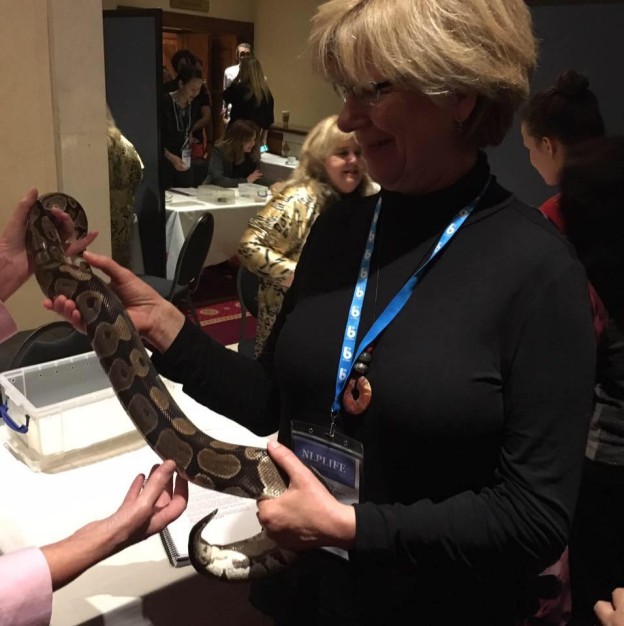
snake-and-donna

And there goes my fear of snakes…

I could tell you all about my fear of snakes, the dreams, the childhood memories, the pictures in my head. Of course, many people are afraid of snakes, spiders, heights, tight places, water, and the list goes on and on.

There is very little training in the world on how to use our brains. Isn’t it amazing…the thoughts that get into our head that become a little obsessive, running over and over and over again like a movie reel. For years, I never even saw a snake, but in my mind, every curved stick was ready to slither and large snakes hid in tall grass. I even had a “strategy” if I encountered a snake on on the bike trail. I would use my bike as a shield between myself and the snake so it could not attack me.

Last week, I had the remarkable experience of spending 7 days in London getting my NLP Certification with NLP masters, Richard Bandler, , John and Kathleen LaValle and the famous British hypnotist, Paul McKenna.

The Fast Phobia Cure is really fast. Within an hour I was perfectly willing to touch a large snake ( it felt like a smooth snakeskin purse) and hold it in my arms, stroking it’s head. This is because the pictures, or the movie I was running in my head got altered. Look at the photo, my life long phobia has disappeared,  and now what I see, hear, and feel is this beautiful creature.

This particular NLP exercise takes us into an imaginary movie theater where we watch our greatest fear, and with a series of visualizations, white out the movie screen. I can only tell you that it worked on every person there. By the way, there were also tarantulas, and a box for those who were claustrophobic. The exercise uses NLP language patterns, especially linkage.

Would you like to get over a phobia or fear? How about a little fear, like fear of prospecting? Prospecting  by the way is not a phobia, it’s just a small fear.

giant-snake

As a Licensed Practitioner of Neuro-Linguistic Programming, I seek to help people work with their own brains. This is NOT therapy and it does not take months or years. If you are interested, please contact me at [email protected]


NEW NLP CLASSES ANNOUNCED FOR APRIL

The application of NLP to anyone in business is extraordinary, especially those of us in sales.

1. NLP is like a “users” manual for the mind. 

What we see and hear is what we think about, and what we think about is what we feel, and what we feel influences our reactions, and our reactions influence our habits which influence our destiny.sales

2. NLP is the study of excellence. It’s an attitude of learning, curiosity, and ways of being in the
world. With NLP strategies, we can have excellence at our fingertips whenever we choose.

3. NLP is the conscious and unconscious modeling of patterns of others. 

4. NLP is not a thing. It is the study of of what works, especially what works well. 

In this short video from Richard Bandler,  he talks about NLP in business and how precise communication and predicates will win over “sloppy” communication.  One of the things you will learn in April’s NLP series is how to be more conscious of what you say and how you say it…which will automatically change the response you get. Some of the patterns you will learn are: Conversation Shifts, Double and Single Binds, Cause and Effect Language, and more. These patterns help close people faster and with ease.

Sign up for the free webinar on April 8th at NOON EDT where I will talk more about what is included in the class series I have developed SPECIFICALLY FOR REAL ESTATE AGENTS.

Here are the dates and sign up for the actual classes: http://neurolinguisticprogrammingcourse.com/

Remember, what you put your attention on expands…
Soft Eyes

Soft Eyes

A State as defined in NLP is ” your actual condition ( emotional, physical and mental), appropriate or otherwise, at any particular moment.”

One of the greatest challenges we face in sales is managing our internal ability to be in a powerful, receptive and energetic state when we are talking to or meeting with clients.

Peripheral Awareness is a process through which you can notice everything that is going on around you and inside you in a way that will relax you and relax your client.

Soft eyes is one of the techniques that you can practice that will enhance your ability to expand your attention and help in difficult circumstances. In most sales situations we are self focused or have tunnel awareness which closes down our ability to view the sales call more resourcefully.

  1. First you will want to simply practice your peripheral vision by being aware of what is above you and beside you. You’ll want to do this by looking straight ahead without moving your eyes left or right or up. Once you master this you will be able to sense more about your clients without ever breaking eye contact.
  2. Most of our day is spent using foveal vision which is that part of the eye which can focus on small things such as threading a needle or looking at a computer screen ( tunnel awareness).
  3. Soft eyes combines foveal and peripheral vision by allowing us to see detail as well as what is happening in the wider perspective. We can still focus on the color of someone’s eyes and see our interaction as if we were observing it in a large picture. Using the soft eyes technique you become more relaxed and it becomes easier to have a meaningful connection.
  4. Practice looking at someone and being aware of a point about three feet behind them and then look at their face. This will alternate between peripheral and foveal vision and start you down the right path. We do this naturally when we drive as we focus on the road and also are aware of the landscape and cars beside us in a defocused way.
  5. Clients will naturally relax when you relax with the soft eyes method. As you practice it, one of the benefits will be that internal dialogue will become less negative. Soft eyes can inhibit stress, procrastination, and anxiety. Would that help you connect and close better?


The Other Side of Behaving Badly…

the-smoking-effect-l-1Behaving badly doesn’t always mean  what we think it does. Have you ever heard this voice?

“I don’t REALLY have to get up at 5 AM. I could work out tomorrow instead. It wouldn’t hurt to skip one day, would it?”

“ I can just skip lead generation today. I can catch up tomorrow.”

Where is that voice coming from? With the best of plans, intentions and New Year’s resolutions, this voice is not helping! Or is it?

One of the most interesting things from an NLP perspective to observe is how this voice is actually INTENT ON HELPING YOU because every behavior has a positive intention.

How is that possible when it’s clear the “voice” is trying to derail what we said we wanted?

Look at these examples of what we would normally call “ Negative Behavior” and how they may be actually be looking out for you.

Smoking- While our rational mind knows that smoking is not a behavior that supports our health, the behavior may help us relax, which has a positive impact.

Fear of making a decision- The positive intention behind fear is usually “safety”. Ever have a seller who followed their fear and backed out of a transaction? Backing out made them feel “ safer” than completing the transaction.

The next time you hear that “voice” or experience a client who is exhibiting a behavior that seems to not be in their best interest, ask yourself…”is there a hidden positive intention here that I can acknowledge?”

For instance, “ I don’t REALLY have to get up at 5 am to work out” . The hidden intention may be comfort. Once we realize the choices and separate them from who we really are, we can simply ask these questions (for ourselves and for clients) :

“Which choice will move me FORWARD toward my goals and dreams?”

“What’s the impact of my choice to my life?”

It could be that backing out of the deal is the most ecological choice for the client. Understanding that every behavior has a positive intention takes the “wrong” out of the equation.

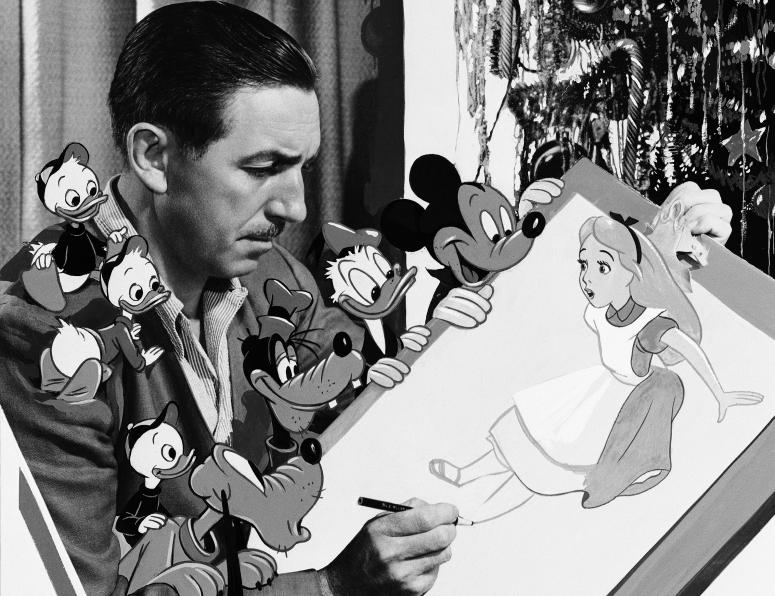
walt-drawing

Business Planning with Walt Disney

walt-drawing

“All our dreams can come true, if we have the courage to pursue them” – Walt Disney

As we move forward in business planning for next year, one way to gain new perspective is to “model” someone  with a genius success strategy . NLP master Robert Dilts studied Walt Disney’s planning strategy through the lens of NLP to uncover the fundamental process of all genius: the ability to take something that exists only in VISIONARY REALITY and solidify it into PHYSICAL REALITY to fulfill Life Intentions. The Disney term “Imagineering” means turning dreams into reality.

We all have strategies that we run, from brushing our teeth to how we run a business. In NLP,  it’s useful to study the mental maps of people like Walt Disney and model the process for our own success. When we build a business/life plan we are using mental abilities to reorganize the world around us in a way that pleases us and pleases those we serve.

Walt Disney’s strategy involved three perceptions that worked hand in hand with each other. Simply put, they were the dreamer, the realist and the critic.  Just like a play or storyboard, he would wear each of those hats and ask his team to do so as well. This involved using three physical positions to separate the perceptions. He would have his team go into three different rooms or sit in three chairs.

Shall we try it? (Essential to this process is having a physical space for each part that is separate)

Place three sheets of paper on the floor of your office in different corners. Write on them with a pen or sharpie and make one the dreamer, one the realist and one the critic.  YOU WILL ACCESS THEM ONE AT A TIME. Don’t rush through this, do it thoughtfully for a breakthrough.

1. Step into the dreamer position. Think about your big goals, and what that looks like a year from now, 5 years from now, 10 years from now. Dream without limits! When was the last time you allowed this to flow? Imagine what it would be like to be on a stage with thousands clapping for you as you win your award? See it, hear and feel it.

2. Now step into the realist position. Look at this through your senses as someone who is actually doing the things you dream about. Experience the action. What would someone who is going to Spain next year see, feel and experience and what would they be doing in physical reality to bring it to life? What plan would they make?

3. Now step into the critics role. Think of a movie critic and you have just presents the story board of your business/life plan. The critic may ask “what’s missing? Or does it work? Does it look right, does it feel right? The purpose of the critic is to make sure that something meets certain criteria and in combination with the dreamer and the realist can create something very extraordinary with very high standards.

If the idea is still alive after the critic looks at it, it then returns to the dreamer position for the work on the project to continue.

One of Disney’s colleagues said, ” …there were actually three different Walts: the dreamer, the realist and the spoiler. you never knew who was coming into your meeting.”

We all know that outcome and legacy of this strategy for Walt Disney. Creativity requires the roles of all three phases that can support each other.

Watch this video as a young girl with a dream goes through the Disney Creative Process.http://www.youtube.com/watch?v=iMMTsbF5KnE


Feet don't fail me now!

The Footwork of Body Language (subtitle: “feet don’t fail me now!”)

ruby-slippers-wizard-of-oz

You played it so well today on the client appointment …except for a couple of actors who didn’t make the rehearsal…YOUR FEET. They didn’t practice and though it seemed like a small thing, they covertly spoke volumes about what you were REALLY thinking with their stance, their toes, and their direction. Your torso faced the client, you made eye contact, but those darn feet were aimed right at the door. Uh oh, the curtain came down and trust was broken!

We are ALWAYS communicating, whether we believe it or not. Clients are always picking up those signals, sorting them and creating meaning. If we are nervous, impatient or bored, as much as we practice, our non verbals will indicate our true intentions. Body language comes very NATURALLY when our mindset is positive, non manipulative, and supportive of our clients. It’s no surprise that your feet will TURN on you, if you are thinking something other than what your non verbal communication is expressing. Mae West said it best, ” I speak two languages, Body and English.”

People WANT to see your feet on an appointment. They will sense that you are more open, more approachable if you let them take in the full view of you from top to bottom. While they may not be looking directly at your feet, they will notice if your weight is not evenly disbursed, or you are rocking back and forth from foot to foot.

Even what happens under a table can be important. Have you ever seen someone with legs crossed who is moving their foot up and down in kind of a mid air tap dance? It’s up to you to determine whether the client is excited or nervous because it could be either. One thing is for sure, when the foot stops moving or FREEZES, there has been a state change, usually indicating a closing up or stress. Poker players for instance are great observers of what is happening with the feet.

What should we do when we notice that our client has one foot out the door? The best thing to do is what we call NLP mirroring and matching to get back into rapport. When they point their feet toward the door, you can wait a few seconds and do the same while slightly leaning back a little. The goal is to be less threatening and rebuild trust. You might lighten the conversation add some humor to give them some room to breathe. Another technique would be to “break state” and say something like, ” I just noticed your shoes, where did you get them?” By bringing attention to the feet, it will send a message to subconscious mind and shift attention away from the escape stance.

Have sensory awareness of everything that happens on an appointment in communication. One way for your own body language to be congruent is to BE CLEAR on yourown internal dialogue and your body will follow. Focus your attention and interest on the other person. Try it!

Looking for Meaning

house, looking for meaning, real estate

After 26 years in Real Estate sales, I’ve come to understand that people are not really looking for houses, they’re looking for meaning. They are not really trying to find a shelter made of boards and plaster with a roof (for most of us already have that basic need met), they are trying to make a decision motivated by some vision or feeling for their future lives. All of the schematic details of construction and financing don’t have as much impact as tapping into this basic truth…what will this mean to them?

When considering a purchase, our client may not even realize their own thought processes that run the show. In most cases, beneath strategic and thinking mind, there is a deeper yearning, yet to be expressed for the house with a porch swing, the swath of wooded land, and the dining room large enough for their table. The “wish” list just scratches the surface of their heart’s desires.

As a new agent, I would often be making careful notes of features on the wish list, thinking that it would be the key to finding the right match. I’d hear other agents say “buyers are liars” in reference to buyers who would pick a house that had little to do with what they “said” they wanted.  Over time, and especially when I started to study NLP, I was able to get deeper into their internal world  and build a closer relationship which inevitably resulted in trust. I started asking questions like…”what will a porch swing mean to you?”.

I began to use specific words and questions to understand their values, criteria, and how they envisioned their lifestyle and future. And that’s what this blog is about…how to create more rapport with clients, use language as a bridge to dreams, and help others  begin a new journey. As you follow this blog, you may learn more about NLP, observe some of my aha moments, and find your own meaning in this job we call sales.

The Secrets of VAK, or ” How mom bought her car”

vak, sales, nlp

NLP offers a wonderful method for understanding the people around us and their preferred way of taking in information and decision making. We all came out of the womb with only our senses to guide us. VAK stands for visual (seeing), auditory (hearing), and kinesthetic (feeling). Simply put, we all make decisions on what we see, hear, and feel in different order. One of these senses usually becomes our dominant representational style from the time we are quite young and never changes.

My mom recently bought a car. She had been thinking and talking about it for a while, so I really wanted to understand her VAK process.

Spending a week in Kansas with her naturally brought out my inner sleuth. Once you learn about VAK, you can’t help but be curious about people’s style and family is a great place to practice. I now share with you some of my Columbo moments. My mother and I are two distinctly different representational styles, so here is an interaction we had on the front porch last night.

Mom: “It’s so quiet out here tonight, I can’t even hear any traffic. The birds are singing but I usually hear more traffic than this. I can’t even hear the trucks on the highway.”

Me: Not talking, just looking in the trees for the birds singing.

Mom: “It’s really quiet. Oh, I heard some geese, did you hear that? And I can hear someone flying one of those model planes.”

Me: “Close your eyes and you can hear the birds.”

You see, my mother is auditory and I am visual. It’s clear as a bell. As you read my words and follow this blog, you will find that I involuntarily use words and phrases that are visual like “see” and “clear as a bell”.

Clues to an auditory: Likes to talk, takes in information by hearing it, often is musical, repeats information, responds to sounds. Mom will hear a noise from anywhere and exclaim, “whats that?”.

Clues to a visual: Likes to see things, takes in information visually, often artistic, color can be important. I have to close my eyes and take away the visual to hear better. ( For instance, when I am prospecting on the phone, I shut my eyes so I can listen to the dialogue without the visual distraction).

In sales, we can use this information to understand how our clients want to be communicated to and how their decision process works.

Mom was thinking about a car. My brother called her and told her about a car he saw. Mom called her trustee and ask him what he thought about it. He told her he thought it would be a good car for her. She had already given the car a green light by ” hearing about it”. At this point she had never even seen the car.

She then when to look at it with her trustee, so that he could advise her.She also liked that if felt somewhat comfortable, although maybe not totally to her liking.

Her process was to hear about it, see it and feel it. Just seeing the car would not have been enough to bring about a decision. Test driving it to get a feel for it would not have been enough. The sale never would have happened if she had not ” heard” about the car first from a trusted party. Her buying pattern is just in this order.

As a sleuth yourself, simply ask people “How did you make your last big purchase?” Keep asking questions and look for the words they use to describe the experience. The understanding of their internal process will lead to a closer relationship, more rapport and greater ease in the sales process.

How To Use House Stories To Create Context For Buyers

“Most of our experience, our knowledge and our thinking is organized as stories.”
—Daniel Pink

When seller’s share their personal story about the home they are leaving, it creates an emotional connection for the future buyer. These sellers valued their outdoor space and created a booklet on Shutterfly highlighting their beautiful yard and patio in all seasons.

house stories

In the booklet they talked about their neighborhood association, access to the creek, how the neighbors like to walk or jog and where the pick up point is for Spiral Path Farms, a local CSA.

house stories

On the patio page, they described their memories around the firepit, the sound of the waterfall and the goldfish and the frogs!

house stories

The winter wonderland page highlighted the beauty of the seasons in the yard, along with reassurance that the snow would not be a problem with an efficient township and friendly neighbors. Other pages included beautiful photos of flowers blooming and how to take care of the raspberry bushes. Interestingly, there was nothing in this book about the house itself. The house had multiple offers (and was priced for the market). It attracted the perfect buyers who were over the top excited about having a nature habitat.

The story of this house created content and context for future buyers. It engaged all the senses so the buyer could see, feel and hear what it would be like to own this property and enjoy Sunday brunch while watching the birds. Descriptive and visual, a buyer could also hold this book in their hands which was warm and fuzzy. Too often we forget to create connection in our marketing.

Want to know the best part? They had an additional copy made for me at closing with a dedication in the front. Do you think I will ever forget this sale? People will never forget when there is meaning.